Understanding the connection between thinning hair, scalp health, strengthening ingredients, and moisture balance.
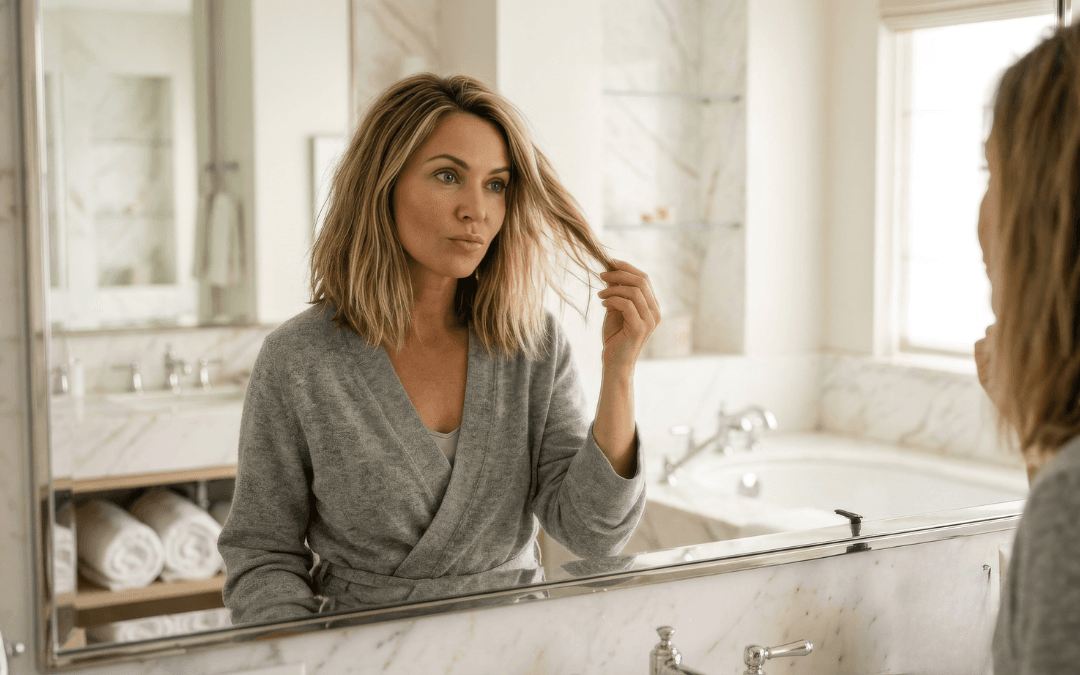
For many women with color-treated hair, experiencing excessive shedding, thinning, or a noticeable loss of fullness can be frustrating and concerning. As their hair feels finer, weaker, or less dense, they naturally look for products that do more than cleanse and condition.
They want a hair and scalp care system that strengthens fragile strands, supports a healthy scalp and follicle environment, reduces breakage, and promotes fuller-looking, healthier hair.
This is why many women turn to specialized strengthening systems, such as FOND Revitalize+ Shampoo and Conditioner. Formulated with botanical proteins, amino acids, biotin, saw palmetto, aloe vera, and carefully selected plant extracts, Revitalize+ supports scalp health while improving the condition, strength, and manageability of fragile hair.
But what happens when you use a strengthening shampoo and conditioner to improve your hair’s condition, only to find your color-treated hair feels dry, rough, stiff, or harder to manage?
You may naturally wonder: “If these products are supposed to strengthen my hair, why doesn’t my hair feel softer, smoother, and more moisturized?”
The answer begins with understanding three essential components of healthy-looking hair:
Your scalp needs the right environment for healthy hair growth. Your hair shaft needs strength to resist breakage. Color-treated hair needs moisture and conditioning to stay soft, flexible, and shiny.
These three objectives—scalp care, hair strengthening, and moisture balance—are interconnected, but they serve different purposes.
For women with chemically processed or color-treated hair, finding the right balance matters most. While strengthening ingredients can improve fragile strands, dry or porous hair may also need extra conditioning and lubrication to stay soft and manageable.
The good news? You don’t have to choose between stronger-feeling hair and beautifully moisturized hair.
With the right mix of strengthening and hydrating products, you can care for fragile hair, improve softness, and help preserve your color.
Let’s explore why dryness happens and how to restore balance.
1. Why Color-Treated Hair Is More Prone to Dryness
Color-treated hair has unique needs, especially after repeated highlighting, lightening, or chemical processing.
During permanent coloring and lightening services, the hair’s protective cuticle and internal structure can change. These changes may increase porosity, reduce surface smoothness, and make the hair more vulnerable to friction, tangling, and breakage.
Think of the cuticle as the protective outer layer of each hair strand.
When the cuticle is relatively smooth and intact, the hair generally feels softer, reflects light more evenly, and is easier to comb and style.
When that protective surface becomes compromised, hair may begin to feel:
- Dry, rough, or straw-like
- Tangled, especially when wet
- Fragile and prone to breakage
- Less flexible and harder to manage
- Dull, frizzy, or lacking shine
Repeated chemical processing can also alter the hair’s natural surface lipids, increasing friction between individual strands.
The key distinction: Dryness doesn’t necessarily mean your strengthening shampoo or conditioner is damaging your hair. It may simply mean your color-treated hair needs extra conditioning, lubrication, and moisture-focused care.
2. Understanding Hair-Strengthening Proteins
One difference between strengthening and moisturizing products is the type of conditioning benefits they emphasize.
FOND Revitalize+ Shampoo and Conditioner contain three hydrolyzed botanical proteins selected to help condition and support fragile hair.
Hydrolyzed Quinoa Protein
A plant-derived protein ingredient that improves hair conditioning and manageability, and helps strands look smoother and healthier.
Hydrolyzed Soy Protein
A botanical conditioning ingredient that helps improve the feel and manageability of hair exposed to chemical processing, styling, and everyday mechanical stress.
Hydrolyzed Baobab Seed Protein
A plant-derived protein ingredient that helps condition and improve the feel of dry, fragile, or chemically processed hair.
Together, these proteins create a strengthening-focused conditioning system for hair that needs extra care.
Can Too Much Protein Make Hair Feel Dry?
You may have heard the term “protein overload.”
Although the beauty industry uses the term commonly, protein overload isn’t a precise scientific diagnosis.
Hydrolyzed proteins interact with hair differently depending on their molecular properties, concentration, formulation, and the hair fiber’s current condition.
Some individuals notice that frequent use of protein-focused products leaves their hair feeling firmer, less flexible, or less soft than they prefer.
However, this doesn’t automatically mean proteins have hardened the hair or caused damage.
For women with highly porous, color-treated hair, the more useful question may be:
“Am I giving my hair enough conditioning and lubrication to complement my strengthening routine?”
Hair can benefit from strengthening ingredients while still requiring additional moisture-focused conditioning.
3. Why Strengthening Products Can Feel Different from Moisturizing Products
Not every shampoo and conditioner delivers the same experience.
Some formulas emphasize lightweight conditioning, body, and manageability.
Others focus on richer conditioning, improved slip, softness, frizz control, and reduced friction.
Both approaches have an important place in professional hair care.
How FOND Revitalize+ Works
FOND Revitalize+ Shampoo combines aloe vera, glycerin, mild cleansing agents, botanical proteins, and selected conditioning ingredients to cleanse and care for the scalp and hair.
FOND Revitalize+ Conditioner combines aloe vera, glycerin, botanical proteins, behentrimonium chloride, cetearyl alcohol, panthenol, and other conditioning ingredients to help soften and detangle fragile hair.
So Why Might Your Hair Still Feel Dry?
Even a well-formulated strengthening shampoo and conditioner may not deliver enough richness or slip for every hair type.
Hair that has been repeatedly highlighted, bleached, or chemically processed often requires more intensive conditioning than hair with minimal chemical damage.
Women with fine or thinning hair face an additional challenge: They want smoother, softer hair without sacrificing volume and fullness.
The solution may be a lightweight strengthening shampoo to cleanse the scalp, paired with a richer conditioner for the more porous mid-lengths and ends.
Strengthening and moisturizing products don’t have to compete. They can complement each other.
4. What About Silicones and Hair Softness?
Silicones are often misunderstood in hair care.
Certain silicone ingredients help improve hair slip, reduce friction, enhance shine, and make damaged hair easier to detangle.
FOND Revitalize+ Conditioner contains no silicones. Instead, it relies on a combination of conditioning agents, fatty alcohols, lightweight emollients, and botanical ingredients.
This approach provides conditioning without relying on silicones.
However, silicones are not inherently harmful, and avoiding them is not necessarily better for every hair type.
For women with highly processed or porous hair, a richer moisturizing conditioner with silicone-based lubricants may add smoothness and help with detangling.
What matters most is choosing products that address your hair’s actual needs.
5. Hair Shedding and Hair Breakage: Understanding the Difference
If you’re experiencing thinning hair, it’s essential to understand the difference between shedding and breakage.
Although both can make hair look less full, they are not the same condition.
Hair Shedding
Hair shedding occurs when a hair is released from the follicle as part of the natural growth cycle.
Excessive shedding may be associated with hormonal changes, stress, illness, certain medications, nutritional deficiencies, or other underlying conditions.
If you notice longer strands falling from the root, sometimes with a small rounded bulb at one end, you may be experiencing shedding.
Hair Breakage
Breakage happens when the hair shaft fractures.
Chemical processing, excessive heat, aggressive brushing, and weakened cuticle structure can contribute to breakage.
If you notice shorter broken pieces, split ends, or uneven hair lengths, breakage may be contributing to the appearance of thinning.
You can experience both conditions at the same time.
Why This Matters
Strengthening and conditioning products can improve hair manageability and reduce friction-related breakage, helping existing hair look healthier.
However, cosmetic products cannot address every underlying cause of excessive shedding or follicle miniaturization.
While losing 50 to 100 hairs a day is typically normal, certain signs suggest excessive hair shedding or thinning may be linked to a medical issue. If you experience sudden or rapid hair shedding, patchy hair loss, or noticeable density loss, consult a healthcare provider specializing in hair loss.
Early evaluation can help identify the cause and the right treatment options.
6. How to Balance Strengthening and Moisture Without Giving Up Your Routine
If your color-treated hair feels dry after using a strengthening shampoo and conditioner, you may not need to abandon your routine.
Instead, adjust how you use your products and give your hair the additional conditioning it needs.
Step 1: Focus Your Strengthening Shampoo on the Scalp
When you wash your hair, focus shampoo on the scalp and roots.
Gently massage with your fingertips rather than scrubbing aggressively.
Let shampoo and water run through the mid-lengths and ends as you rinse.
Avoid rubbing fragile, color-treated ends together repeatedly.
This approach cleanses the scalp while reducing unnecessary friction on more delicate lengths.
Step 2: Alternate with a Moisturizing Conditioner
If your hair still feels dry after using Revitalize+ Conditioner, consider alternating it with FOND Hydrate Conditioner.
For example, cleanse with Revitalize+ Shampoo and follow with Hydrate Conditioner when your hair needs extra softness, slip, and manageability.
FOND Hydrate Conditioner contains conditioning ingredients, botanical oils, emollients, and shea butter to help improve the feel of dry, color-treated hair.
It also contains botanical proteins, so it isn’t protein-free.
For finer hair, concentrate Hydrate conditioner on the mid-lengths and ends to avoid weighing down the roots unnecessarily.
Step 3: Try Pre-Shampoo Conditioning
If your ends are extremely dry, apply a small amount of conditioner to the most fragile sections before shampooing.
Then cleanse your scalp, rinse, and condition normally.
This technique may help reduce friction during washing and improve manageability.
This step is optional, and you can adjust the amount of conditioner based on how your hair responds.
Step 4: Protect Your Hair with Leave-In Conditioning
Color-treated hair often benefits from additional care after rinsing.
FOND Nourishing+ Leave-In provides lightweight conditioning to help improve detangling, manageability, and the feel of fragile hair.
Apply it mainly to the lengths and ends, where hair typically experiences the most cumulative chemical and styling exposure.
For additional shine and frizz control, use a small amount of FOND Hydrate Hair Oil on the ends as a finishing treatment.
Step 5: Adjust Your Washing Frequency
No single washing schedule works for everyone.
The right frequency depends on scalp oil production, hair texture, styling habits, and personal needs.
If your hair feels rough after frequent washing, try a gentler routine or alternate strengthening products with moisture-focused formulas.
The goal is to keep the scalp clean and comfortable without subjecting fragile hair to unnecessary friction or excessive washing.
7. The FOND Approach: Start with the Scalp, Strengthen the Hair, and Protect the Color
At FOND Hair & Scalp Care, we recognize that women experiencing shedding or thinning often face several concerns at once.
Their scalp may need attention.
Their hair may be fragile and prone to breakage.
Their color-treated lengths may lack softness, flexibility, and shine.
That is why we believe a personalized hair care routine is more practical than expecting one shampoo and conditioner to satisfy every need equally.
FOND Revitalize+ Shampoo & Conditioner
A strengthening-focused hair and scalp care system formulated with botanical proteins, aloe vera, biotin, saw palmetto, and selected botanical extracts.
Cleanses, conditions, and supports stronger, more manageable hair.
FOND Hydrate Shampoo & Conditioner
A moisture-focused cleansing and conditioning system designed to improve softness, detangling, and manageability, particularly for dry or color-treated hair.
FOND Nourishing+ Leave-In
Provides extra conditioning and daily care to help fragile hair feel smoother and easier to manage.
FOND Blume Scalp Serum
A lightweight botanical scalp serum that complements a consistent hair care routine and supports a healthy scalp environment.
FOND Hydrate Hair Oil
A lightweight finishing treatment that helps smooth frizz, enhance shine, and improve the feel of dry ends.
You don’t necessarily need every product. The goal is to select the products that address your scalp’s needs and your hair’s condition.
8. Listen to What Your Hair Is Telling You
Your hair’s needs can change over time.
Chemical services, heat styling, environmental exposure, aging, and changes in hair density can all influence how your hair looks and feels.
A routine that worked beautifully several months ago may require adjustments as your hair’s condition changes.
If your hair feels stronger but less soft, incorporate additional moisture-focused conditioning.
If it feels smooth but gets flat or weighed down, use less conditioner or apply it more heavily to the ends.
If your scalp is comfortable but shedding continues, investigate potential underlying causes rather than relying solely on cosmetic products.
The most effective hair care routine responds to your hair’s actual condition—not simply the product category printed on the label.
Final Thoughts: Healthy-Looking Hair Requires Balance
If your color-treated hair feels dry after using a strengthening shampoo and conditioner, it does not automatically mean the products are harming your hair.
Your hair may need a different balance of strengthening, conditioning, lubrication, and moisture-focused care.
The key is recognizing that your scalp and hair have different—but equally important—needs.
Your scalp needs a healthy environment. Your hair shaft needs protection against breakage. Color-treated hair needs the right conditioning to stay soft, flexible, and shiny.
Strengthening and moisturizing are not competing goals. Together, they help you care for fragile hair while keeping it softer, smoother, and fuller-looking.
At FOND Hair & Scalp Care, our philosophy is simple:
Start with the scalp. Care for the hair. Protect the color.
Beautiful, healthy-looking hair begins with understanding what your hair truly needs.
Discover Your Personalized FOND Hair & Scalp Care Routine
Explore the Revitalize+ Strengthening System, Hydrate Moisture Collection, and FOND’s complete scalp and hair care solutions at fondhaircare.com.