
In today’s professional hair care landscape, innovation has largely centered around one idea: repairing damage after it occurs.
From peptide-based technologies to bond-building systems, modern formulations promise to reconnect broken structures within the hair fiber—particularly after chemical services such as bleaching, coloring, and heat styling.
While these technologies represent a significant advancement, they also raise an important question:
👉 Is repairing damaged hair enough to achieve long-term hair health?
Or is there a more complete approach—one that prevents the cycle of damage from repeating?
Understanding Peptide Repair Technology
Peptide-based leave-in treatments are designed to penetrate the hair shaft and reconnect broken keratin chains at a molecular level.
These formulations typically rely on:
- Synthetic or bioengineered peptides
- Solvent-based delivery systems (often including alcohols and glycols)
- Lightweight conditioning agents
Primary Benefits
- Immediate improvement in hair strength
- Reduction in breakage
- Enhanced internal structure after chemical damage
Limitations
- Focuses exclusively on the hair fiber—not the scalp
- Does not address root causes of thinning or shedding
- Solvent-heavy systems may contribute to dryness with frequent use
What Are Bond Builders?
Bond-building products work by reinforcing or rebuilding disulfide bonds within the hair structure—bonds that are often broken during chemical processing.
These systems are widely used in professional salons during:
- Lightening and bleaching services
- Hair coloring
- Chemical treatments
Primary Benefits
- Structural reinforcement during and after chemical services
- Reduced breakage during processing
- Improved resilience of compromised hair
Limitations
- Primarily a reactive solution (used during or after damage)
- Limited influence on hair growth, scalp health, or long-term density
- Often requires continuous use to maintain results
The Missing Link: The Scalp and Follicle Environment
Hair is not a static fiber—it is a biological extension of the scalp.
Every strand originates from a follicle, and that follicle is influenced by:
- Circulation and nutrient delivery
- Hormonal balance
- Inflammation and oxidative stress
- Scalp hydration and pH
If the scalp environment is compromised, the result is often:
- Increased shedding
- Thinning hair
- Reduced growth cycle efficiency
- Weak, fragile strands
No amount of bond repair or peptide technology can fully compensate for a dysfunctional scalp environment.
A More Advanced Approach: Scalp-First, Multi-Pathway Hair Care
A new generation of professional formulations is shifting the focus from repairing damage to optimizing the entire hair growth ecosystem.
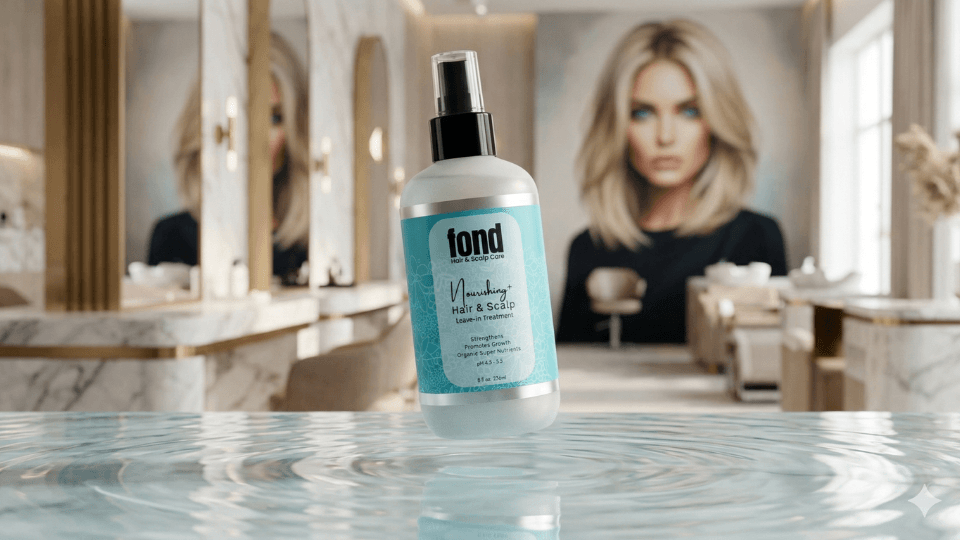
One such approach is found in FOND’s Nourishing Plus Hair and Scalp Care Leave-In Treatment, which integrates scalp health, follicle support, and fiber reinforcement into a single daily-use system.
How FOND’s Scalp-First Leave-In Treatment Works
Unlike traditional repair systems, this type of formulation is designed to support hair at every level:
1. Bioactive Hydration Base
- Organic Aloe Vera serves as the primary ingredient
- Maintains hydration while supporting the scalp’s natural barrier
- Promotes a balanced environment for healthy follicle function
2. Growth and Shedding Support
- Biotin helps strengthen the hair structure
- Saw Palmetto supports a balanced hair growth cycle
- Green Tea provides antioxidant protection against follicle stress
3. Multi-Protein Strength Complex
- Quinoa Protein
- Rice Protein
- Baobab Protein
These proteins work synergistically to:
- Improve elasticity
- Reinforce the hair shaft
- Reduce breakage without stiffness
4. Scalp Balance and Comfort
- Lavender extract helps calm irritation
- Xylitol supports moisture retention and barrier function
- pH balanced between 4.5–5.5, aligning with the scalp’s natural acid mantle
5. Lightweight Conditioning System
- Advanced conditioning agents provide detangling and smoothness
- Coconut-derived emollients mimic natural lipids
- Leaves hair soft, manageable, and full—without buildup
Peptide Repair vs. Bond Builders vs. Scalp-First Care
| Category | Peptide Repair | Bond Builders | Scalp-First Leave-In |
|---|---|---|---|
| Primary Focus | Internal fiber repair | Structural bond reinforcement | Scalp + follicle + fiber health |
| Timing | After damage | During/after chemical services | Daily prevention + support |
| Scalp Benefits | Minimal | Minimal | Significant |
| Hair Growth Support | None | None | Strong |
| Hydration System | Limited | Moderate | Advanced |
| Long-Term Results | Temporary repair | Maintenance-based | Progressive improvement |
What This Means for Long-Term Hair Health
Peptide and bond-building technologies are valuable tools—particularly for correcting damage after chemical stress.
However, they are not designed to:
- Reduce chronic shedding
- Improve scalp health
- Support new hair growth
- Enhance long-term density and fullness
A scalp-first approach addresses these gaps by focusing on prevention, balance, and biological support.
The Strategic Shift in Professional Hair Care
The most advanced salons and consumers are beginning to recognize a critical truth:
👉 Repair alone is not a complete solution.
To achieve lasting results, hair care must evolve from:
- Damage correction → to system optimization
- Surface treatment → to biological support
Conclusion: Building Hair That Doesn’t Need Constant Repair
Peptide repair and bond builders play an important role in modern hair care—but they are inherently reactive.
True transformation occurs when the focus shifts to:
- Strengthening hair before it becomes compromised
- Supporting the scalp environment
- Enhancing the natural growth cycle
A well-formulated, scalp-focused leave-in treatment provides this foundation—delivering not just stronger hair today, but healthier hair for the future.
Final Insight
The future of hair care does not lie in fixing what is broken.
It lies in creating hair that is stronger, more resilient, and less likely to break in the first place.