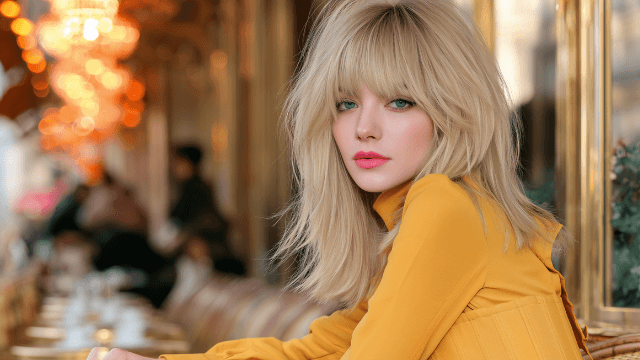
The modern shag—defined today by soft curtain bangs, elevated interior layering, natural movement, and seamless lived-in color—is one of the most resilient silhouettes in hair history.
What modern salons may describe as an effortless, texturized shag or wolf-cut hybrid is actually the product of more than 50 years of evolving haircut architecture, styling techniques, color chemistry, and cultural influence.
From the rebellious razor cuts of the early 1970s to today’s polished, dimensional interpretations, the shag has continually reinvented itself without losing what made it iconic: movement.
To understand how today’s modern shag came to be, we have to look at how five decades of technique transformed an anti-establishment haircut into a sophisticated staple of contemporary salon design.
The 1970s: The Anti-Establishment Birth of the Shag
The shag emerged as a rejection of the rigid bouffants, structured sets, and heavily controlled silhouettes that dominated much of the 1960s.
One of its defining early moments came when hairstylist Paul McGregor created Jane Fonda’s famous haircut for the 1971 film Klute. The silhouette was revolutionary for its time—layered, deliberately imperfect, highly mobile, and adaptable enough to feel almost unisex.
The Cut
Early-1970s shags relied on short crown layers, fragmented fringe, interior weight removal, and extensive razor work.
Unlike the highly constructed hairstyles that preceded them, these cuts were meant to move.
The result was raw, rebellious, and intentionally imperfect.
By the mid-to-late 1970s, the silhouette softened and grew more glamorous. Farrah Fawcett’s famous feathered hairstyle, created by Allen Edwards, transformed aggressive shag layering into expansive face-framing movement and swept-back “wings.”
The shag had moved from counterculture into mainstream beauty.
The Color
Hair color technology was considerably less sophisticated than it is today.
Highlights were commonly created with highlighting caps—often called “frosting”—or larger, higher-contrast sections of lightener. The result was generally less blended than today’s dimensional techniques.
Warm golds, honey blondes, and occasionally brassy tones were common because modern toning systems, bond-building technology, and today’s highly customized color formulations had not yet been developed.
The Style
Hot rollers, round brushes, backcombing, and strong aerosol hairsprays were essential tools.
Hair was deliberately pushed away from the face, creating the characteristic feathered movement that defined the decade.
The objective was simple:
Movement, volume, and attitude.
The 1980s: Extreme Geometry and High-Octane Volume
As the 1980s arrived, the softer feathering of the previous decade became dramatically more exaggerated.
Punk, new wave, glam rock, and heavy-metal culture pushed the shag silhouette toward extreme interior elevation, fragmentation, and volume.
The Cut
The 1980s introduced increasingly dramatic disconnection.
Crown layers became shorter to create vertical height, while the perimeter often remained considerably longer. This architecture helped give rise to the mullet, rock-and-roll shag, and countless variations built around dramatic length differentials.
Stylists used point cutting, slicing, razoring, and thinning techniques to create highly shattered interiors.
Hair became architectural.
The Color
Contrast was everything.
Dark bases were frequently juxtaposed against platinum sections, heavily lightened crowns, or vivid fashion colors.
Double-process blonding became increasingly common, while bold panels and pronounced highlights reflected the decade’s visual excess.
Subtlety was rarely the objective.
The Style
Perms added structural density and helped support enormous silhouettes.
Crimping irons, root teasing, directional blow-drying, strong mousse, gels, and high-hold hairsprays were routinely used to push hair upward and outward.
The shag had become bigger, louder, and more theatrical.
The 1990s: The “Rachel” and the Refinement of Disconnection
The 1990s reacted against the previous decade’s excess.
Hair became smoother, cleaner, more polished, and considerably more wearable.
The shag did not disappear—it evolved.
Its most commercially influential descendant was the layered haircut popularly known as “The Rachel,” worn by Jennifer Aniston on Friends.
The Cut
Instead of the harsh disconnections characteristic of many 1980s styles, 1990s layering became more cohesive.
Face-framing sections flowed into square or rounded interior layers while maintaining enough elevation through the crown to create fullness.
The perimeter became cleaner and stronger, often sitting around the jawline, shoulders, or collarbone.
Rather than exploding away from the head, the haircut increasingly curved inward toward the face.
The Color
Foil highlighting became the dominant salon technique, gradually replacing highlighting caps for sophisticated color work.
Caramel, pecan, honey, and beige highlights were woven throughout the haircut to accent movement and face framing.
Contrast remained visible, but placement became much more controlled.
The Style
The oversized round brush became one of the decade’s defining tools.
Hair was blown smooth with carefully directed airflow, creating polished, rounded bevels through the ends.
Heavy aerosol sprays gradually gave way to lighter glossing serums and finishing products.
Hair still had volume—but now the finish was polished rather than rebellious.
The 2000s–2010s: Flat Irons, Deconstruction, and the Balayage Revolution
During the early 2000s, the traditional shag temporarily receded as ultra-straight hair, flat irons, and long extensions dominated salon culture.
Hair became smoother, longer, and less layered.
But by the mid-2010s, beauty culture began moving again toward natural texture, individuality, and less obviously styled hair.
The shag returned.
The Cut
The new interpretation was frequently described as the bohemian shag, modern shag, or eventually the wolf cut.
Stylists increasingly used slide cutting, dry cutting, point cutting, channel cutting, and strategic internal weight removal to create movement without destroying perimeter density.
Heavy side-swept bangs gradually evolved into softer, center-parted curtain fringe.
Unlike the fragmented shags of previous decades, modern versions were designed to appear effortless while remaining technically controlled.
The Color
This period transformed professional hair color.
Balayage, foilyage, shadow roots, root melts, and dimensional toning replaced the obvious striping associated with many earlier highlighting techniques.
Instead of beginning every highlight directly at the scalp, colorists increasingly painted light through the mid-lengths and ends while maintaining natural-looking depth near the root.
The result was the rise of lived-in color—dimensional, sophisticated, and significantly more forgiving during grow-out.
The Style
The classic round-brush blowout temporarily gave way to flat-iron bends and large-barrel curling irons.
Rather than creating perfectly uniform curls, stylists alternated direction, disrupted the curl pattern, and frequently left the ends straighter.
The objective became intentional imperfection.
Hair was supposed to look styled—but never overly styled.
The Modern Era: Precision Structural Shags and Lived-In Dimension
Today’s shag represents the sophisticated culmination of more than five decades of haircutting evolution.
It retains the rebellious, piecey spirit of the original 1970s silhouette while incorporating modern precision cutting, advanced color chemistry, scalp-conscious hair care, and far greater respect for the hair’s structural integrity.
The Cut
Modern shags often use approximately 90-degree elevation in selected interior areas to build organic crown volume while preserving a denser perimeter.
Curtain bangs are often longer and softer, sweeping around the cheekbones and blending gradually into face-framing layers.
Deep point cutting, slicing, and strategic internal texture can produce visible separation without making the haircut appear thin or over-layered.
This distinction matters most for clients with fine, thinning, or heavily color-treated hair.
Modern haircutting is no longer simply about removing weight.
It is about understanding where weight should remain.
The Color
Today’s most sophisticated versions of the shag rely on dimensional color rather than obvious highlighting.
A Level 6 or 7 shadow root, for example, might transition gradually into Level 9 or 10 beige, champagne, or pale-gold blonde through carefully placed foilyage.
Modern toning has moved far beyond the simple warm-versus-cool approach of previous generations.
Colorists now manipulate subtle combinations of gold, beige, pearl, champagne, violet, neutral, and natural tonal families to create individualized finishes.
At the same time, protecting hair condition has become increasingly important.
Highly layered hair exposes more surface area and movement throughout the silhouette, which means dryness, porosity, breakage, frizz, and compromised ends can become immediately visible.
For that reason, the modern shag is as dependent upon healthy hair as it is upon exceptional haircutting.
The Modern Styling Philosophy: Movement Without Stiffness
Modern styling balances control with freedom.
Directional round-brush drying can create lift through the crown while sweeping curtain bangs away from the face.
A curling iron or styling wand can then add alternating bends through the mid-lengths while leaving selected ends straighter.
The final result should move.
Dry texture sprays, lightweight finishing products, flexible hairsprays, and carefully applied oils can enhance separation and polish without collapsing the haircut.
The best modern shag should never appear frozen.
It should look touchable, dimensional, healthy, and effortless.
Where FOND Hair & Scalp Care Fits Into the Modern Shag
As haircutting and color techniques have evolved, professional hair care has evolved with them.
Today’s salon client is asking more of a hairstyle than clients did several decades ago.
Hair may simultaneously be highlighted, toned, layered, heat-styled, exposed to environmental stress, and expected to remain shiny, flexible, soft, and healthy-looking between salon visits.
That’s where a scalp-first approach to professional hair care becomes increasingly relevant.
FOND Hair & Scalp Care was developed around the philosophy that beautiful hair does not begin only at the ends.
It begins at the scalp.
Start With the Scalp. Care for the Hair. Protect the Color.
The FOND system supports modern salon clients who want to maintain a healthy scalp environment while caring for fine, thinning, color-treated, dry, or environmentally stressed hair.
For a haircut like the modern shag—where movement, texture, separation, and dimensional color are constantly visible—hair condition becomes part of the design itself.
FOND Revitalize+
FOND Revitalize+ Shampoo and Conditioner provide the system’s cleansing and strengthening foundation, supporting hair that needs body, resilience, and manageable conditioning without overwhelming the haircut’s natural movement.
For modern layered styles, preserving movement is critical. Excessively heavy conditioning can collapse crown elevation and make carefully constructed layers disappear.
FOND Hydrate
FOND Hydrate Shampoo and Hydrate Conditioner provide moisture recovery for clients—particularly those with fine-to-medium, color-treated hair—who need softness, slip, and manageability while maintaining movement.
This becomes especially valuable after highlighting, balayage, foilyage, or other lightening services, where maintaining moisture balance can directly influence how polished the finished haircut looks.
FOND Blume Scalp Serum
The modern conversation about beautiful hair increasingly includes the scalp.
FOND Blume Scalp Serum is a lightweight daily scalp treatment designed to support a healthy scalp environment and complement a scalp-conscious hair-care routine.
For clients concerned about scalp condition, visible thinning, or excessive shedding, incorporating dedicated scalp care creates another dimension of the salon-home maintenance relationship.
Rather than treating the scalp as an afterthought, modern hair care recognizes it as the environment where hair grows.
FOND Nourishing+ Leave-In Treatment
FOND Nourishing+ Leave-In Treatment adds lightweight conditioning and daily protection while helping preserve manageability through highly layered areas.
This is especially useful with shag haircuts because the shorter interior layers and face-framing sections often face more heat exposure during blow-drying and styling.
FOND Hydrate Hair Oil
Finally, FOND Hydrate Hair Oil can be applied selectively through the mid-lengths and ends to smooth frizz, enhance shine, restore softness, and define the separation that makes a modern shag visually compelling.
The objective is not to coat the hair heavily.
It is to refine the finish while allowing the haircut to retain its natural movement.
Fifty Years Later, the Philosophy Has Changed
The history of the shag tells a larger story about the evolution of professional hairdressing.
In the 1970s, the rebellion was against rigid styling.
In the 1980s, the objective was exaggeration.
In the 1990s, it became polish.
In the 2000s, it became deconstruction.
And today, the best hair design combines all of those lessons with a new priority:
hair and scalp health.
The modern shag is no longer simply a collection of layers.
It is a carefully engineered relationship between shape, movement, color, texture, scalp condition, and hair integrity.
From Jane Fonda’s rebellious Klute haircut to today’s dimensional blonde curtain shag, the silhouette keeps evolving because it has always represented something larger than fashion.
It represents freedom.
Freedom from rigid structure.
Freedom to embrace natural movement.
Freedom to personalize texture and color.
And increasingly, freedom to create beautiful hair without ignoring the health of the scalp and hair beneath the style.
That is the philosophy behind modern hairdressing—and the philosophy behind FOND Hair & Scalp Care:
Start with the scalp. Care for the hair. Protect the color.