
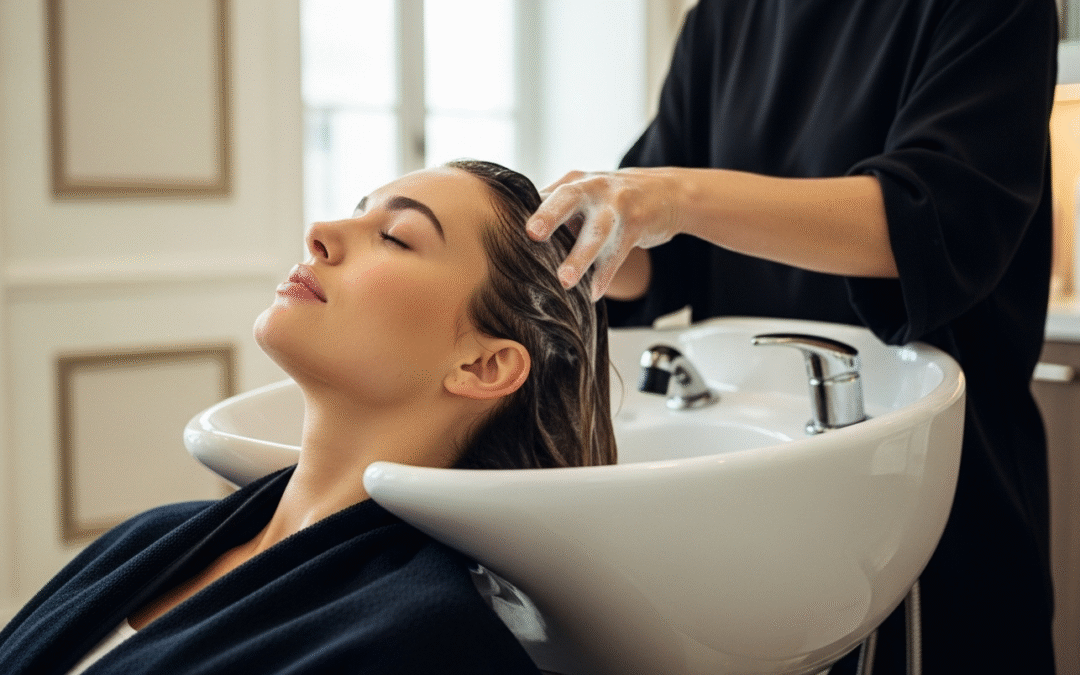
Unfiltered municipal and well water can leave mineral and metal residues on the hair and scalp, interact adversely with color and bleach, and increase dryness, roughness, and breakage—particularly in fine or thinning hair. Evidence shows that hardness minerals (such as calcium and magnesium) and trace metals (notably copper and iron) deposit on the cuticle, altering its mechanical properties. Disinfectants, such as chlorine/chloramine, can contribute to dryness and color changes. Additionally, metals can catalyze peroxide reactions during bleaching, which increases damage and leads to unpredictable color results.
Below you’ll find (1) the science in brief, (2) practical diagnostics, (3) proven water-purification options for home and salon, (4) color/bleach protocols to reduce risk, (5) heat-styling guardrails for fine/thinning hair, and (6) a lightweight regimen using FOND Hair & Scalp Care to restore scalp comfort, moisture balance, and strength.
How Unfiltered Water Affects Hair & Scalp
1) Hardness minerals (Ca²⁺, Mg²⁺).
Hard water deposits primarily concentrate in the cuticle layers, altering fiber mechanics (stiffening, altering combability, and a rougher feel). Several studies have reported measurable effects on hair properties after exposure to hard water, including reduced strength and altered styling behavior.
2) Disinfectants (chlorine/chloramine).
Residual chlorine/chloramine is effective for public-health disinfection but can dry hair and irritate skin; chloramine is harder to remove than chlorine (important when choosing filters). The EPA notes that chloraminated water that meets standards is generally safe for bathing; however, sensitive individuals may experience irritation.
Copper is the classic culprit for “green” casts—especially on light/blonde or porous hair—and it can catalyze hydrogen peroxide decomposition during oxidative color/bleach, leading to faster, harsher reactions and more breakage or color shift.
Private wells may contain elevated bacteria, nitrates, iron/manganese, or other contaminants. Routine testing is recommended to guide the proper treatment.
Why It Matters for Color & Bleach
- Unpredictable lift & tone: Copper/iron on the hair shaft accelerates peroxide reactions; results include banding, off-tone reflects, and fragility.
- Greater structural damage occurs at higher processing temperatures and alkalinity: Oxidative bleaching progressively degrades cuticle and cortex proteins; excessive or repeated bleaching amplifies this effect.
Diagnose Before You Treat
- Identify your water profile.
- For city water, review your local Consumer Confidence Report (CCR) and note whether your utility uses chlorine or chloramine, plus hardness and metals.
- For private wells, test annually for bacteria, nitrates, TDS, and pH; expand panels (iron, manganese, arsenic, lead) based on local risk.
- Salon quick checks.
- Client intake: Ask about well-water, old copper pipes, green discoloration, rapid fading, or a “grippy” feel.
- When results matter (bleach/balayage/vivid): perform a chelation/demineralization pre-service as standard.
Water Purification That Actually Helps
For showers (hair/scalp exposure):
- Chlorine reduction: Choose a shower filter certified to NSF/ANSI 177 (chlorine reduction). Example: Aquasana AQ-4100, independently tested to reduce >90% chlorine.
- Chloramine caution: Chloramine requires catalytic carbon and a longer contact time; many shower filters do little against it. If your city uses chloramine (e.g., Los Angeles, Boston, Philadelphia), consider whole-house or under-sink catalytic-carbon systems or RO for water used in mixing chemical services/rinses.
For homes/salons (point-of-use or whole-house):
- Carbon block filters with catalytic carbon (for chloramine) and softeners (for hardness) are practical upgrades; verify claims via certifications: NSF/ANSI 42 (chlorine/taste/odor), 53 (health contaminants like lead), and 58 (reverse osmosis).
- Countertop/RO units can supply low-TDS water for color mixing and final rinses when water quality is challenging. (Look for NSF/ANSI 58 for RO.)
Pro tip: For high-risk services (platinum lifts, vivid colors on porous hair), keep distilled/RO water on hand for final rinses and dilution—this is a minor detail, but it makes a big difference in predictability.
Salon Protocols to Minimize Metal & Mineral Interference
- Pre-service demineralization/chelation (mandatory on blonding or compromised hair):
- Use a detoxifying shampoo with (ascorbic acid + EDTA blend) to remove mineral/metal buildup.
- During color/bleach:
- Use lower developer volumes; process visually.
- Avoid exposing metals to excessive heat, as they can catalyze the decomposition of peroxides.
- Post-service:
- Acidify to a pH of 4.5–5.5; finish with FOND Nourishing Plus Leave-In Hair & Scalp Treatment. A lightweight, silicone-free leave-in to seal and protect without weighing down fine hair.
Heat-Styling Guardrails for Fine & Thinning Hair
- Temperature: Keep flat-iron settings ~250–300 °F (121–149 °C) for fine/thinning hair; avoid routinely exceeding 185 °C (365 °F)—higher temps show markedly greater structural damage.
- Technique:
- Style only on 100% dry hair (wet/damp hair + irons = bubble hair and micro-cracks).
- Use a single, controlled pass with light tension; limit touch-ups.
- Blow-dry on medium heat with a concentrator kept more than 6 inches away; finish on cool setting.
- Always use a lightweight thermal protectant that is compatible with fine hair.
At-Home Routine Featuring FOND (Lightweight Moisture + strength)
Goal: Re-balance scalp, remove mineral/metal residue, and reinforce fine, thinning, color-treated hair—without heaviness.
- 2–3×/week cleanse: FOND Revitalize+ Shampoo (aloe-based; gentle surfactants) to break up residue while maintaining scalp comfort.
- Condition: FOND Revitalize+ Conditioner for pH-balanced (≈4.5–5.5) slip with baobab/quinoa proteins for feather-light strength and elasticity.
- Treat/Protect: FOND Nourishing+ Hair & Scalp Leave-In for light moisturization and scalp support (aloe, botanical extracts).
- Weekly reset (if hard water/chlorine exposure is high): Add a vitamin-C or chelating treatment before your regular FOND wash; follow with FOND conditioner and leave-in treatment. (For color longevity, do this at least 24–48 hours after fresh color application.
- Environment: Install an NSF 177 shower filter (if chlorinated) or step up to catalytic-carbon/RO solutions if chloramine or metals are documented in your CCR or well tests.
Quick Reference — Do / Don’t
Do
- Check your CCR (city) or test wells annually and choose filtration based on the actual contaminants present.
- Chelate/demineralize before blonding, vivids, or heavy chemical work.
- Keep the heat low (250–300 °F) and pass minimal; protect every time.
Don’t
- Assume all shower filters remove chloramine; most do not—verify media (catalytic carbon) and certifications.
- Bleach over unknown metal buildup. (Strand test + chelation first.)
- Style with irons on damp hair.
Suggested, Vetted Starting Points
Salon pre-service demineralization: Use a chelating shampoo with absorbic acid and EDTA.
Shower (chlorine): Aquasana AQ-4100—independently tested to NSF/ANSI 177 for chlorine reduction. (Good entry point for city water that uses chlorine.)
If your city uses chloramine: Favor catalytic-carbon whole-house or under-sink solutions or RO for service/rinses; match to your CCR.